Model Context Protocol in 2026: The Standard That Lets Enterprise AI Agents Touch Real Systems
 ElchaiJuly 3, 2026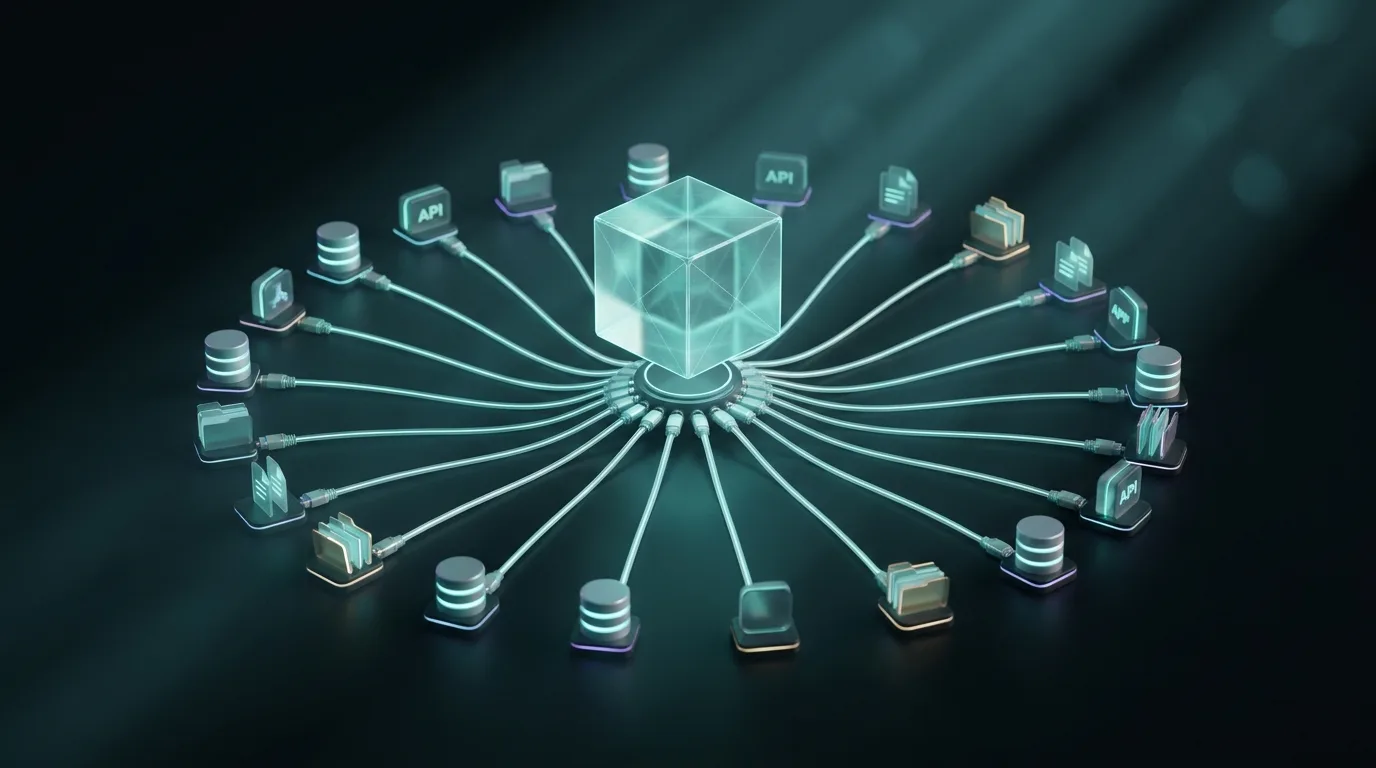
Model Context Protocol (MCP) is an open standard that lets an AI agent connect to the tools, data and systems it needs — a CRM, a database, a payments API, an internal file store — through one consistent interface instead of a bespoke integration for each. Anthropic open-sourced it in November 2024, and within a year OpenAI, Google, Microsoft and AWS had all adopted it. For an enterprise the significance is blunt: MCP is becoming the wiring that decides what your agents can reach, which makes it a security and governance decision as much as a technical one.
What is the Model Context Protocol, in plain terms?
It is a universal connector between AI models and everything outside them. The official documentation calls MCP "a USB-C port for AI applications" — one standardized way to plug an agent into external systems, replacing the tangle of custom integrations each tool used to require (Model Context Protocol docs). Before MCP, connecting an AI agent to ten internal systems meant ten hand-maintained integrations. MCP collapses that into one protocol: a tool exposes an "MCP server," the agent runs an "MCP client," and any compliant model can use any compliant tool. The value isn't cleverness; it's that the connection stops being custom.
Why did every major AI company adopt MCP within a year?
Because a shared protocol is worth more to all of them than a proprietary one is to any single player. Anthropic released MCP in November 2024 as "a new standard for connecting AI assistants to the systems where data lives" (Anthropic, 2024). Four months later OpenAI adopted it — Sam Altman said "people love MCP and we are excited to add support across our products" (TechCrunch, March 2025). Microsoft made MCP generally available in Copilot Studio in May 2025, AWS shipped an MCP server for Bedrock AgentCore in October 2025, and Google announced official MCP support for its services in December 2025. It's the classic pattern for infrastructure standards: interoperability beats lock-in once the market is large enough.
Who controls MCP now that it is an industry standard?
No single vendor — since December 2025 it sits under a neutral foundation. Anthropic donated MCP to the newly formed Agentic AI Foundation, a directed fund under the Linux Foundation, alongside Block's goose and OpenAI's AGENTS.md, with AWS, Google, Microsoft, Bloomberg and Cloudflare among the platinum members (Linux Foundation, December 2025). This matters more than it sounds. A standard governed by one company is a dependency; a standard governed by a vendor-neutral foundation is closer to a public utility you can build on without betting on a single roadmap. It's the same reason enterprises trust HTTP or Kubernetes rather than any one owner's API.
What are the security risks of connecting agents through MCP?
Real, and already documented — the protocol that makes agents powerful also widens their attack surface. The most-discussed class is the "tool poisoning" attack: a malicious MCP server hides instructions inside a tool description that the model reads but the user never sees, turning a helpful agent into an exfiltration channel. Researchers at Invariant Labs demonstrated it in April 2025, using a poisoned tool to leak SSH keys. Two critical remote-code-execution flaws were also patched during 2025 — CVE-2025-49596 in Anthropic's MCP Inspector, rated CVSS 9.4, and CVE-2025-6514 in the mcp-remote client, rated 9.6 (eSentire, 2025). None of this makes MCP unsafe to use; it makes MCP something you deploy with the same Web3 cybersecurity discipline of least privilege and limited blast radius you'd apply to any system that can act.
The failure modes cluster into a few recognizable classes:
- Tool poisoning: hidden instructions inside a tool's description hijack the agent's behavior — catalogued by OWASP as MCP03:2025.
- Prompt injection: untrusted content the agent reads — a web page, a document, a support ticket — smuggles in commands it then follows.
- Confused deputy: the agent is tricked into using credentials or tokens it was legitimately given for an attacker's ends.
- Over-broad scope: an MCP server granted more access than the task needs turns a small compromise into a large one.
What does MCP change for enterprises in the GCC?
It lowers the integration cost that has been the real barrier to agentic AI in the region — while raising the governance bar. Gulf AI ambition is set at the national level: the UAE's National Strategy for Artificial Intelligence 2031 targets global leadership, and Saudi Arabia's Vision 2030, through the Saudi Data and AI Authority, treats data and AI as core economic infrastructure. In that context the constraint has rarely been ambition; it's been connecting agents to legacy core-banking, ERP and government systems while meeting data-residency and Arabic-language requirements — exactly the bespoke-integration problem MCP standardizes away. The same sovereign AI logic applies: a shared protocol lets an institution keep models and data on domestic infrastructure while still plugging agents into the systems that run the business.
How should an enterprise adopt MCP without opening a hole?
Treat every MCP server as a privileged integration, not a plugin. Gartner forecasts that over 40 percent of agentic AI projects will be cancelled by the end of 2027 on cost, unclear value and weak risk controls — and MCP sits squarely in that risk-controls column. Four practices carry most of the weight. Vet and pin your servers, running trusted, version-locked MCP servers rather than pulling arbitrary ones from the internet, since a poisoned server is the primary attack vector. Scope each connection to least privilege, so an agent reaches only the data and actions a task genuinely needs. Log every tool call as an auditable trail, because an action an agent took through MCP is one you must be able to reconstruct later. And keep a human approving consequential operations while agents own the repetitive, bounded ones — the same discipline that separates the agentic-payment deployments that work from the ones that leak. Gartner also expects 40 percent of enterprise apps to feature task-specific agents by 2026; the organizations that benefit will be the ones that governed the wiring before the volume arrived.
Frequently asked questions
What is the Model Context Protocol in simple terms?
MCP is an open standard that lets an AI agent connect to external tools and data through one consistent interface, instead of a custom integration per system. Anthropic open-sourced it in November 2024, describing it as "a USB-C port for AI applications" (Anthropic, 2024). By late 2025 OpenAI, Google, Microsoft and AWS had all adopted the same standard.
Is MCP secure enough for enterprise use?
It can be, with the right controls. MCP is a protocol, not a security product, and 2025 surfaced real issues — tool-poisoning attacks plus two critical remote-code-execution flaws, CVE-2025-49596 (CVSS 9.4) and CVE-2025-6514 (CVSS 9.6) (eSentire, 2025). Enterprises that pin trusted servers, scope least-privilege access and log every tool call use it safely; those that connect arbitrary servers do not.
Do I have to use MCP to build AI agents?
No, but it's becoming the default. You can still build agents with bespoke, hand-maintained integrations, and plenty of production systems do. MCP's advantage is that it replaces many custom connectors with one protocol any compliant model can speak — which is why every major AI platform adopted it within a year and why it now sits under the Linux Foundation rather than a single vendor.
How does MCP relate to agentic payments?
MCP is the layer that lets an agent reach a system; an agentic payment is one thing it can do once connected. An agent that plans a purchase still needs a way to call the checkout or settlement API — often through an MCP server — before the payment protocols take over. The two are complementary; see our guide to agentic payments for the money side of the same shift.
ELCHAI Group builds and governs enterprise AI agents across the GCC and Europe, wiring them to real systems through MCP with the identity, least-privilege and audit controls that production automation demands.